

Have you ever dreamed of having complex things in real life and then in front of your eyes? Interactive simulations simply do this — namely, they make theory become experience. In every digital learning, interactive instruments are necessary in the present age of learning. With the quality education in India ever evolving, the coaches and online coaching centers are utilizing these simulations to make concepts less complex, develop confidence, and make the learning process more interesting. This blog will discuss how interactive simulations can lead to the actual mastery of concepts and why they can symbolize the essence of good education in the modern world.
Overview of Interactive Simulations
Interactive simulation is an online setting in which learners have the ability to handle variables, experiment, and graphically display abstract concepts in real-time. They offer practical experiences compared to the fixed images which are not limited by physical means.
To cite an example, students of physics can use the online simulation in order to work with motion, gravity, and friction without a lab. In the same manner, learners of chemistry can be able to mix compounds virtually and view the results in a safe manner.
Such simulations are a combination of visual learning, gamification, and practically experiencing abstract concepts. They have become a core part of the majority of developed online coaching centers in India.
The Importance of Interactive Simulations in Learning
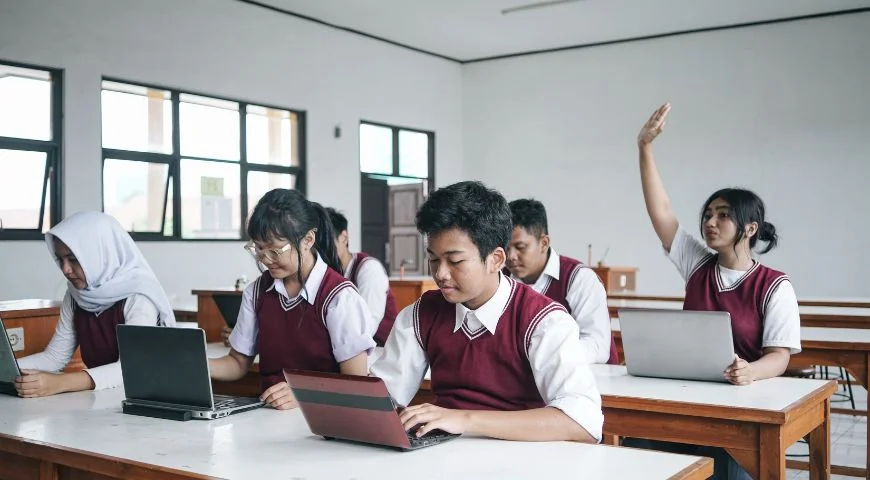
Quality education is relevant because it will assist students in knowing why rather than what. Interactive simulations are in line with this objective as they transform learning into an active process. This is why they are so successful:
- Boosts Concept Retention
Students who do not memorise information but rather experiment tend to remember more. Simulations make use of visual and kinesthetic memory which enhances remembering during exams or applications.
- Promotes Research and Enquiry
Students are free to make hypotheses. This discovery fosters scientific interest, critical thinking and self-assurance in addressing issues in the real world.
- Simplifies Complex Topics
Simulations are useful to visualize difficult concepts such as the structure of atoms, aerodynamics, or human anatomy which otherwise would be abstract in books.
- Encourages Risk-Free and Safe Learning
Simulated environments provide learning opportunities when mistakes are made. There are no fears about resource waste and harm since the students can fail, retake the work, and experiment.
- Promotes Self-Managed Learning
Interactive modules enable students to learn at their pace which is critical with regards to quality education in India, particularly in the digital platforms and coaching programs.
Essentials of Successful Interactive Simulations
High-quality simulations have the following common features in order to become effective in learning:
- Simulated to Life: The more realistic a simulation is, the more the learner can easily understand some elaborate concepts.
- Instant Feedback: Instant feedback helps to boost conceptual knowledge.
- Parameters Available for Customization: The students will have the ability to modify parameters, which will assist them in analyzing cause-effect relationships.
- Combination with Curriculum: The use of simulations in school or competitive exam syllabi will result in focused learning.
- Collaborative Aspects: The use of groups and common experiments helps to enhance communication and teamwork.
These are the aspects that make simulations something more than a mere digital tool — they are living extensions of learning settings inside the classroom or online.
The Principles of Interactive Sims
There is a need to be strategic in using simulations. The following is a basic process as used by most contemporary teachers and web-based coaching groups:
- Determine the Learning Objective: Decide on what concept or problem needs to be explained with the help of the simulation.
- Choose the Right Tool: Select the right simulations, which are precise, curriculum-related and interactive.
- Participate in Practical Discovery: Students should be encouraged to experiment, see and reason.
- Reflect and Apply: Discuss findings, compare results and relate findings and theoretical knowledge.
- Assess Understanding: Quizzes or discussions should be used to assess the understanding of the concepts and the ability to solve the problem.
This process will make sure that learners do not simply pass through simulations but rather actively participate and acquire real-life understanding.
Mistakes and the Way to Prevent Them
Simulations are effective, but may be defeated when abused. The following are some of the frequent errors:
- Reliance on technology without a direction on how it should be interpreted.
- Application of simulations with no explicit goals.
- Negligence towards post-activity reflection or discussion.
- Concentrating on images and disregarding critical thinking.
In order to eliminate them, educators and students are supposed to use simulations as complementary tools — not in place of analytical work. The combination of guided explanation and interactivity would yield the most successful results.
Future in Interactive Learning India
Growth of quality education in India is directly related to the growth of digital and experiential tools. With AI and VR-based simulations implemented into online coaching centers, students are now able to conduct experiments virtually — physics laboratory, space mission, and so on.
Learning will be even more realistic in the future with the coming of augmented reality, adaptive simulations, and the gamification of learning. These tendencies do not only enhance academic knowledge but equip students for applicability and problem-solving in the real world.
Ready to Learn by Doing?
You are sick of reading the same things repeatedly, so it is high time you should experience them. Research a virtual coaching facility which combines simulation, visual education and practical learning. Interactive learning is the ability to know through example, i.e., to observe theories in practice.
Conclusion
The future of quality education in India is represented by interactive simulations. They bring technology, innovation, and interaction together in order to make learning count and stick. Their effective application enables students to get beyond rote learning and learn the concepts at a deeper level. Adopting simulations is not only a digital innovation issue; rather, it is about redefining the significance of a good education for a more intelligent and inquisitive generation.
Follow Decluttered on Instagram, YouTube, LinkedIn, and Facebook — where learning gets simpler.


0 Comments