

Innovation is supported by the STEM education or Science, Technology, Engineering, and Mathematics. However, not all students can find its applicability in reality. During the traditional teaching, emphasis is usually on memorization rather than imagination. The result? Students are aware of the theory but not inquisitive to invent. This blog discusses the impact of practical work through projects in enhancing STEM education and the use of online coaching centers in bringing about change in education in India.
Introduction to Hands-on Learning in STEM
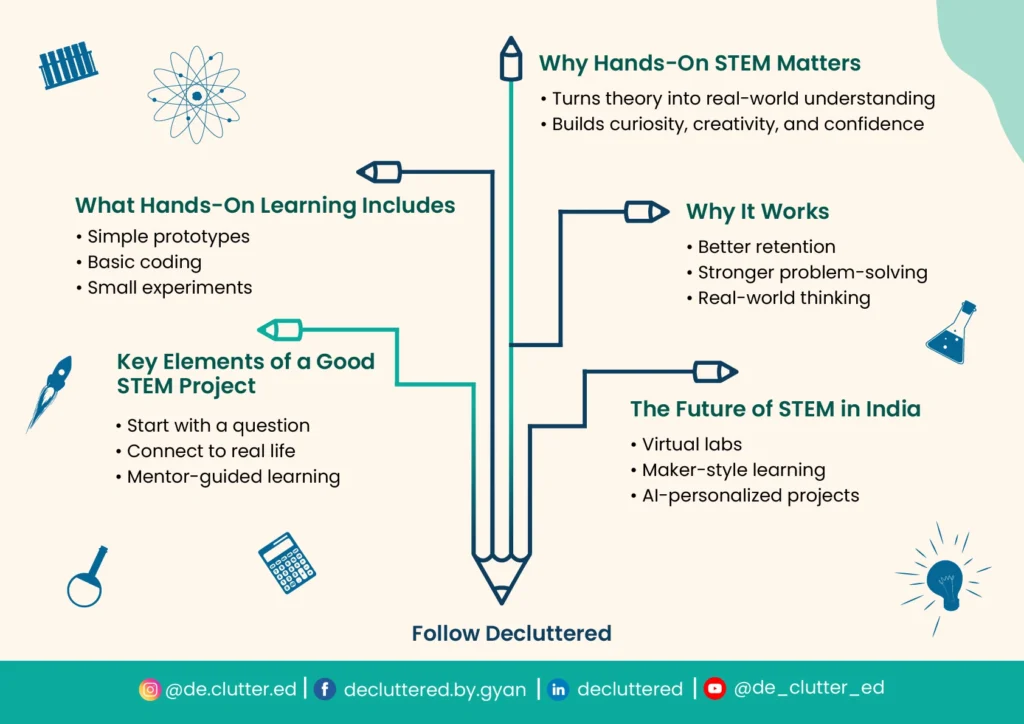
Learning hands on refers to learning through doing. It engages students to experiment, create, and solve problems, as opposed to reading or listening.
This can be applied in a STEM setting and it can entail:
- Creation of models or prototypes in order to test scientific ideas.
- Simple programs that drive logic and automation need to be coded.
- Carrying out experiments between textbook theory and concrete outcomes.
This will assist in bridging the disconnect between the concepts in the classroom and the real-world innovation – to ensure learning becomes active, engaging and creative.
Why Project-based Learning is Important in STEM Education

Quality education is important in enabling the students to think and not merely get high grades. Practical projects are crucial to the realization of that.
- Enhances Innovation and Problem Solving
Experimentation of students exposes them to undesirable outcomes- they are compelled to think and be creative.
- Enhances Student Retention and Comprehension
Students have been found to remember up to 75 percent of information during experiential learning as opposed to passive learning procedures.
- Builds Confidence
They accomplish projects, however minor, with a feeling of ownership and pride in the process of learning.
- Encourages Collaboration
Teamwork is usually part of STEM projects, and it teaches students how to communicate, share ideas and solve problems as a team.
- Fosters Real-World Thinking
Hands-on learning links abstract theories and real-life application as opposed to the rote memorization that is the real meaning of quality education in India.
Important Building Blocks of a Successful STEM Project
To make a hands-on learning process effective, some conditions need to exist:
- Inquiry-Based Approach
Questions should be used to initiate the projects and not instructions. Of the question why, it is important that students delve into it prior to the how.
- Interdisciplinary Connection
STEM projects combine a variety of disciplines – e.g. coding (technology) and mechanics (engineering).
- Real-World Context
Learning is relevant socially and makes sense when it is done through tasks that address real community or environmental problems.
- Mentor Involvement
Teacher or mentor guidance, particularly through an online coaching center, will help to make sure that creativity is goal-focused and organized.
- Continuous Reflection
Students are expected to evaluate what went well, what did not and what can be better after finishing every project.
The Practical Presentation of Hands-on Learning
The process within a systematic program of STEM curriculum is as follows:
- Introduction to the concept: The fundamental theory is introduced to the students first.
- Problem Definition: They are provided with a practical challenge associated with the concept.
- Experimentation: The pupils develop, trial and work on prototypes or solutions.
- Mentorship and Feedback: The instructors take the students through refinements and revisions.
- Presentation and Reflection: Students and reflect on learning results.
This strategy is what makes STEM active discovery as opposed to passive study.
General Obstacles and Their Solutions
- Limited Access to Tools
Not every school or student will be able to access laboratories or materials.
Resolution: Supply virtual laboratories and online coaching centers to provide the solution by using digital simulation and virtual laboratories.
- Time Constraints
Projects often do not fit into rigid curriculums of teachers.
Solution: Integrate smaller, modular projects, which are in line with the existing lessons.
- Fear of Failure
Students might be afraid to experiment because of a possibility of going wrong.
Resolution: Promote the growth mentality – perceiving any unsuccessful trial with innovation as a step to be made.
Indian STEM Education: The Future
The future of quality education in India is in the combination of creativity and technology. More being embraced in schools and online coaching centers are:
- Remote experimental virtual labs.
- Maker programs in order to promote do-it-yourself innovation.
- Artificial Intelligence powered learning devices that individualize projects to the capacity of students.
In 2030, the STEM learning ecosystem in India will probably prioritize creators and not crammers – hands-on projects will be the central part of learning.
Ready to Learn by Doing?
When you are interested in making STEM more interesting and motivating, you should find an online coaching center that promotes projects and experiments. It is not what people read about science that makes them creative, it is doing it.
Conclusion
Real-world STEM education fosters curiosity and creativity and confidence the pillars of good education in India. It turns students into active innovators as opposed to passive learners. Such projects have the potential to trigger a lifelong interest in learning when they are overseen with constructed mentorship and assisted by digital technology – one experiment at a time.
Stay inspired with Decluttered — follow us on Instagram, YouTube, LinkedIn, and Facebook for learning tips, exam insights, and student success stories.
FAQs
- What do you consider to be examples of practical STEM projects?
Assembling basic robots, designing an environmentally friendly one, writing computer code, or following a circuit design – all of them count as concrete STEM education. - Why are practical learning more effective in STEM?
It is a combination of theory and practice, which allows students to practice knowledge and acquire problem-solving skills.
What are some of the ways that online coaching centers could facilitate STEM learning?
They offer virtual laboratories, professional mentoring and systematic advice to students who are not attending physical laboratories.

0 Comments